CAREER ADVANCEMENT CELL
Training & Career Guidance
Guiding towards one's destination — from first semester to final placements.
ABOUT CAC
About the Career Advancement Cell
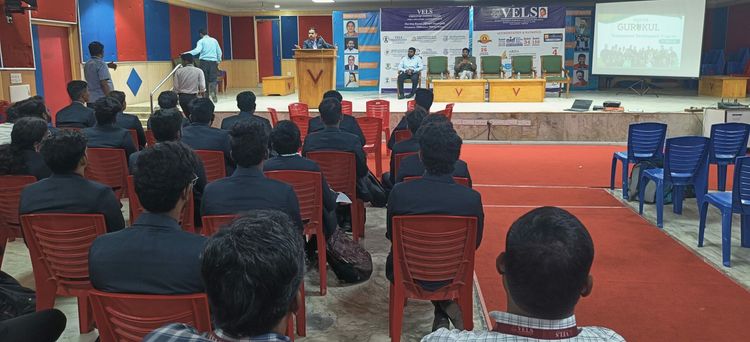
The Career Advancement Cell (CAC) of VISTAS works for the professional development of students and equips them to make the most of the career opportunities available to them. From the first semester to the final year, CAC supports students in every area of skill development and career advancement, including placements, internships, government job and competitive exam preparation, foreign language learning and higher education abroad.
PURPOSE
Vision & Mission

Vision
To equip students with relevant professional skills and guide them towards a corporate career, higher studies or government jobs.
Mission
Bridge the gap between the needs of the industry and the skills of our students. Build confidence through curricular, co-curricular and extra-curricular activities. Develop competence through internships and pre-placement training. Keep students engaged throughout their course through seminars, workshops and guest lectures.
GOALS
Objectives
- Provide personality development, communication skills and aptitude training so that every student can face interviews with confidence.
- Conduct technical skill-enhancement sessions that help students clear selection processes successfully.
- Motivate students through career guidance and counselling.
- Guide students towards higher education in reputed institutions overseas.
- Place students across diverse sectors in reputed organisations, with packages in line with industry standards.
What CAC Offers
-
Module 1 · Awareness & Training
Awareness programmes
- UPSC
- Bank exams
- NET / SLET / JRF
- Military, Defence and Air Force
Training
- Aptitude
- Personality development and grooming
- Counselling and mentoring
-
Module 2 · Placement
- Invite companies of repute
- Organise pre-placement talks
- Co-ordinate aptitude tests
- Co-ordinate the selection process
- Internships and final placement
- Onboarding to the job
-
Module 3 · Additional Coaching
- Foreign languages
- IELTS coaching and exam
- Higher studies opportunities abroad
ELITE PRACTICES
How the Training Works
All students are eligible for the integrated training programme, which begins from the first semester. The programme follows a stage-by-stage roadmap, “Elite Practices – Road to Success”, with separate tracks for Circuit branches (which include technical training) and Non-Circuit branches.
- Orientation – a ten-day orientation, along with English and personality development classes.
- Placement Assessment Test (PAT) – an online assessment in Verbal, Reasoning and Quantitative ability (V, R, Q), giving each student an individual score card.
- Mentor meetings – mentors meet students to review their score card and plan improvement.
- Focused sessions – training on Verbal ability, Logical reasoning, Quantitative ability and, for Circuit branches, Technical ability.
- Continuous evaluation – weekly tests and monthly tests, followed by repeat assessments to track progress.
- Interview skills – final-stage training to prepare students for interviews.
ROAD TO SUCCESS
Training Roadmap: 3-Year Degree Programme
Semester-wise plan for Non-Circuit and Circuit branches. PAT = Placement Assessment Test; V = Verbal, R = Reasoning, Q = Quantitative.
| Semester | Non-Circuit Branches | Circuit Branches |
|---|---|---|
| 1 | Soft Skills & Communication I | Soft Skills & Communication I |
| 2 | Soft Skills & Communication II | Quantitative Aptitude / Logical Reasoning I |
| 3 | Quantitative Aptitude / Logical Reasoning I | Technical I |
| 4 | Quantitative Aptitude / Logical Reasoning II | Technical II |
| 5 | Interview Skills I | Quantitative Aptitude / Logical Reasoning II |
| 6 | Interview Skills II | Interview Skills I |
ROAD TO SUCCESS
Training Roadmap: 4-Year Degree Programme
Semester-wise plan for Non-Circuit and Circuit branches.
| Semester | Non-Circuit Branches | Circuit Branches |
|---|---|---|
| 1 | Soft Skills & Communication I | Soft Skills & Communication I |
| 2 | Soft Skills & Communication II | Soft Skills & Communication II |
| 3 | Quantitative Aptitude I | Quantitative Aptitude / Logical Reasoning I |
| 4 | Logical Reasoning I | Technical I |
| 5 | Quantitative Aptitude II | Technical II |
| 6 | Logical Reasoning II | Quantitative Aptitude / Logical Reasoning II |
| 7 | Interview Skills I | Interview Skills I |
| 8 | Interview Skills II | Interview Skills II |
Training Guidelines
-
Roles & Responsibilities
- Identify the training needs of each student
- Assess students before and after training
- Allocate hours in consultation with the departments
- Frame the syllabus in line with the core subject
- Allot trainers and schedule the hours
- Maintain records of each student's readiness for placement
-
Eligibility & Registration
All students are eligible for the integrated training programme, which starts in the first semester.
No separate registration is required; every student signs the declaration form CAC Form-3.
-
Training Process
- Training is scheduled to meet the needs of every student, with in-house or outsourced trainers.
- Students are expected to maintain discipline and respect their trainers.
- Assessments count towards subject credits and must be completed on time.
- Issues about syllabus coverage or a trainer can be raised with the HoD or the Training Head at CAC.
- Missed sessions are recorded as absent and are taken into account in any placement query.
- Attendance is compulsory; continuous absence is treated as indiscipline and bars placement registration through CAC.
-
Non-Adherence
- Complete assignments and assessments on time
- Participate actively in every session
- Meet the attendance criteria prescribed by the institution
- Not clearing assessments can lead to hall tickets being withheld for examinations
Career Readiness Workbook
Exercises and checklists to prepare for aptitude tests, group discussions and interviews, from the Career Advancement Cell.